Thursday, August 25, 2011

Pictures

Between 7 people we have 7 cameras. The result is a multitude of pictures for every situation imaginable. Hopefully we will be able to recreate our travel experience for the rest of the Peru team when we go back to school. Until then, here are a few shots to let you guys see what we've been up to.

Samne is beautiful. Everybody should come visit it at least once and drink pineapple juice.


Why ride on a comfortable car seat when you can ride in the back? Los chicos cool.


And the trash problem. It actually does exist, though not too many townspeople seem preoccupied about it. Emily has many more lovely trash pictures on her camera.


Shout-out to Garrett Disco. This is your bridge! When cars cross it you can dinstinctly see the bending. Seeing it almost makes we want to do some stress/strain calculations.


Team posing in the Pitajaya post our meeting with the community. Afterwards we walked down to a huaca (sacred place from pre-Incan times) that was nearby, but sadly we could only find fragments of pottery.


This is the house we were suppose to stay in, but did not because they had not finished repairing it yet. Imagine our surprise when we discovered that the color scheme they chose was orange and black. Coincidence? I think not.


I pretended not to know these guys as they posed while we hiked around the Pitajaya. Seriously, who are they?


Group picture at our house in Samne! The two non-travel team members are Alan, the mayor of Samne, and Brian, the current Peace Corp Volunteer in Otuzco.


Sometimes the tech team actually does stuff. Just kidding. They work hard all the time!


Being in Samne is a lot like going on OA sans the 40-ton packs. Lots of sweating but a million-dollar view.


Group picture with people from the Pitajaya, a caserio of Samne. We met with them to talk about their lack of potable water.


The design team strutting their Tyvex Suits. Yes, even playing with sewage can be fun.
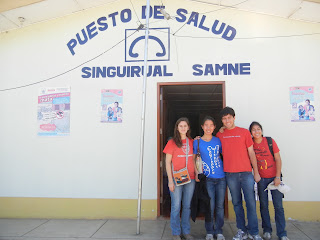


The health post in Samne is well-stocked. There is a doctor, two nurses and two technicians.


Well those are all the photos for now! Expect more at the end of the trip!

This is Tom's Post

On Thursday, August 18, the technical team was scouting the banks of Rio Moche for a suitable location for water quality monitoring. Team members observed an area where surface vegetation and surface soils had been removed. Upon closer examination of this area they observed massive crack in the soil characteristic of those formed when soils with a high clay content are dried. They marked this site to return for infiltrometry measurements.

On Friday, August 19, the technical team did conduct infiltrometry measurements and found that this location required 55 minutes to absorb 15 milliliters of water from the water reservoir. This infiltration rate corresponds to clay soils according to the users manual. The device used was a Mini Disk infiltrometer manufactured by Decagon Devices with the suction control tube set at 2 cm.

On Saturday, August 20 the technical team conducted a second on another portion of the site and found 45 minutes required for drawdown of 15 milliliters which again indicates a tight soil but not as tight as the former site. For comparison purposes the team conducted an infiltration measurement on a bank of sand on the edge of the river and measured a drawdown of 80 milliliters in 30 seconds, characteristic of a coarse sand.

This area and the clay content are significant for the following reason. When a sanitary landfill is constructed in Samne there must be a barrier to prevent landfill leachate from percolating into ground water. Deposits of low permeability clay could potentially be used in lieu of or in addition to a synthetic membrane.

We subsequently learned that this disturbed area is controlled by a mining company that is prospecting for silver. There were workers in the area handling drums of chemicals and mixing them in shallow impoundments.

The outcrop of soil material is obviously sedimentary in nature as the vertical profile has distinct bands of perfectly horizontal strata which vary in color and texture. These horizontal deposits are on top of eroded rubble and boulders on the valley floor. The geomorphology of this site is unknown to the team but the following mechanism is postulated as an imaginary yet plausible sequence in order to further describe these deposits. Perhaps at some time in the remote past a landslide or avalanche blocked the flow of the river and created a large lake. Over a long period of time this lake became a sedimentation basin in which eroded material carried by the river settled under the influence of gravity, and following Stokes Law, the largest particles settled at the upper, shallow end of the lake and the finer materials settled in the deeper regions of the lake. These sediments would then overlay the existing rubble in the river bed as observed. Eventually the material blocking the river eroded away and the lake drained and the sediments emerged as dry ground.

If the preceding hypothesis is reasonably correct then it follows that this large deposit of fine-grained soil material may be a rare phenomenon in the Rio Moche valley. Elsewhere in the Samne region all exposed soil profiles are unconsolidated deposits comprised of rock and soil mixed randomly. This particular outcrop along the river is the only location observed where there is fine soil free of rock. This being the case we recommend that this outcrop be preserved for as source of materials for construction and operation of the landfill.

This exact site is not appropriate for the location of a landfill because it is within the valley bottom and the elevation is probably below the level of peak floods. Therefore a landfill at this site could be eroded during a flood and buried waste would be washed loose and into the river flow. For clarity, it is restated that we consider this material to be good for the construction of a landfill but this exact location to be unsuitable for a landfill.


A New Perspective


As a member of the technical team, before coming to Peru I was really excited about the engineering aspects of our planned projects. This is the first time that I would be designing something real. Something that would actually be realized and affect people’s lives. And in fact, studying ORFE (la ingeniería de dinero as Michelle has so kindly described it to Peruvians), I realized that working with EWB might be one of the few times I could work on engineering design projects. Meanwhile, though I definitely did also recognize the developmental and social aspects of our trip, without seeing the community and the lives of people here, the difficulties of an impoverished life weren’t yet tangible coming from the sheltered and privileged life I have always comfortably led.


Interestingly, though, I have seen people living in severe poverty before. Having lived in India and having visited there many times, I have seen that the experiences depicted in Slumdog Millionaire, though sensationalized by Hollywood, are very real in their most basic sense. However, my personal visits to India have been vacations, and in fact, I have often cherished more luxuries there than in America, including chauffeurs and chefs at my family homes. Moreover, I have never been to India with the intent of helping others and, thus, the lives of those less privileged have unfortunately been out of sight and out of mind with each night’s cozy sleep.


As soon as I stepped into Samne, I saw many things the people here could use help with. Their houses are made of mud bricks and steel roofs. Sewage gets dumped out at the bottom of town, and there is a hillside longer than a football field covered in their piles of trash. There isn’t a paved road in town and pipes are often sticking out in the streets where the thin PVC has been repaired. For a while, I couldn’t bring myself to understand how people could live like this. Still, those on the team who had previous experience with international development kept repeating their surprise about how nice the facilities and buildings in Samne are.


This differences between our perceptions continued to astound me until the reality of poverty hit me full force during our trip to the Pitajaya caserío of Samne. Going there we walked a thin path through the mountainside that was hand carved by the townspeople. After our climb there, the community’s lieutenant general greeted us—his hand calloused and hardened by years of hard labor. As we walked through the town, we passed a little boy, about five years old, whose clothes and skin were patched with dirt and whose toes were sticking out of the ripped front flap of his shoe.


When we got to the community’s water source, however, it immediately became apparent why this is the main source of disease and concern. The water is stored in open concrete chambers with whatever else falls in. Furthermore, it comes directly from the Rio Moche—a river contaminated with mining waste and with no signs of life within. In the meeting that followed shortly thereafter, townspeople mentioned that while they try to boil it and add chlorine, tired workers and children often drink water crude from the source. Unfortunately, with no system of flowing water in houses or filtration, such problems are almost inevitable.


As the meeting passed, the difficulties of life in Pitajaya became further apparent. Parents constantly fear for the wellbeing of their children who are most susceptible to waterborne disease and electricity is something the community will have to wait for because of the impediments of bureaucracy. The one moment I can never forget, though, came around the end of the meeting. An older man repeatedly thanked us for just considering helping them and said multiple times, “Dios nos escucha.” God listens to us. This gratitude was for the basic necessity of potable water. Something that we take so easily for granted, but something for which people all over the world can only hope. This man’s words truly and honestly sent a shiver down my spine and made me realize that the people in this town who work so hard to carve their roads by hand and to bring everything from food and furniture to their homes by foot only barely get by every day.


Nonetheless, meeting with them also made me realize one other thing. It showed me how much hope they had. Despite having hardships in life, everyone in Picajaya seemed content. Though they still do not have electricity or clean water after years of asking the government for it, our presence still made them optimistic for improvement. The trip to Picajaya has helped me realize that people, no matter in what situation, make a fulfilling life for themselves.


From Sao Paulo to Samne

8/21

Being from São Paulo, the largest city in Brazil, made me feel pretty much at home in Lima. In fact, except for the (slight) language difference and the Inca Kola instead of Guaraná, everything else seemed very much like what I was used to back home. For example, it took us over three hours and a hundred dollars to retrieve the testing equipment we’d shipped to Peru because of creeping bureaucracy and uncooperative officials – just like it would in Brazil.
However, when I first got to Samne last week I was struck by how different the city and the lifestyle were. Samne is a small town, a winding dirt road up a mountain, with houses on each side of the road. The first thing that caught my eyes was the scenic mountainous landscape: Samne is surrounded by mountains in the Andes, that go up to 10 000 ft. Down below, meanwhile, the houses are made of widely different materials. They range from a few nice brick houses, to a majority made of adobe, and to a few even simpler houses with bamboo walls stuffed with mud.
In economic terms, perhaps surprisingly, the differences don’t seem as big. Most of the families seem to make their living either off agriculture (there are several small plantation sites around) or working in Trujillo, a city about an hour and a half away from here. Some people also have stores, where you can buy very basic things, like bread, milk or chocolate (a daily necessity for us). For everything else, though, you need to go to Trujillo.
The life here in a lot of ways reminds me of an idealized country life. People don’t have Internet access, nor do they seem to spend a lot of time watching TV. They do, however, spend a lot of time playing soccer and volleyball, or simply talking to each other. Every morning, a bread woman goes through the city, house to house. As you walk, everyone says hola or buenas. Everyone knows and talks to the mayor; he even hangs out with us most of the time.
It’s easy to get carried away by this impression and forget about the problems the city faces. While the streets seem pretty clean, if you look closer down the mountains you will see huge trash dumping sites, or the untreated sewage being thrown right into the river. The tap water is contaminated and unfit for human consumption. Samne is a charming city, but it has lots to improve.

8/23

After being in Samne for about a week, I think it is fair to say we all got used to our lives here. The houses that first impressed us because of their simplicity now just seem another element of the landscape. I thought that the rest of our time here would be spent getting more accurate data on the pollution or interviewing more people, to refine our understanding of what they think and what they want. As Lord Kelvin said about Science in the late 19th century, it seemed all we had to do now was improve a few decimal digits the measured values of our constants.
It turned out however, that just as Relativity and Quantum Physics proved Lord Kelvin was mistaken in thinking so, our visit to Pitajaya, a hamlet of samne, proved we were mistaken in thinking we had more or less figured things out. Unlike Samne, Pitajaya has hardly any amenities: no electricity, no roads. Their drinking water comes from Río Moche, one of the most polluted rivers in Peru; it is stored in a pre-Incan reservoir, and is used without any treatment. It was hard for me to grasp how people would live in such a place; Samne suddenly seemed such a nice place to live in comparison.
The people there were very glad to know that we were considering doing something for them. In a little meeting we had (which even had a written documentation signed by all of us and the mayor), they agreed that having a proper water source was their main concern right now. Perhaps we’ve found our project!

I meant to think of a title but never did

As my time in Samne draws to a close, I’m very excited to get back to Princeton and share our findings with the rest of the team. For me, our trip started out with the rude awakening that a landfill would not be an appropriate first project for this community. The interest of the members of Samne was simply elsewhere; as of right now, throwing their trash down the ravine on one side of town puts the garbage out of sight and out of mind, and few people see the potential benefits of a better waste management system. After talking to some of the other volunteers in the area, it seems like this attitude towards waste disposal is a consistent problem all over the country, and changing this mindset, while a worthy project, will require a much stronger relationship with the people of Samne.

As the head of the design team, I had spent many hours of this past year preparing for the construction of a landfill, and even though we knew that our first project was uncertain, it was still disorienting to have to stop the design process in its tracks and start again from square one. Not knowing exactly what project we would be working on with the community definitely made me nervous. So I was very glad when we began asking around town for other potential projects and got a number of good suggestions. One that immediately jumped out was bringing a potable water system to the casserillo of La Pitajaya, a section of Samne that lies off in the mountains a ways and lacks much of the infrastructure present in the main section of town (electricity and potable water for starters).

On Monday, after a ride in the back of a pick-up truck that started out as exhilarating and ended up a little too death-defying for my tastes, we ended up in Pitajaya for a meeting with the town. I was immediately impressed by how hard-working, friendly, and intelligent the people were. They are close enough to developed towns and cities to know what amenities they are missing. They know their water isn’t fit to drink, they know they need to boil it in order to avoid getting sick, but for children playing outside and adults working in the hot sun all day, the reality is that this doesn’t always happen. My respect for the road that brought us there (a rocky, 7-foot wide path that seemed to me like an avalanche waiting to happen) immediately skyrocketed after hearing that they had carved that road out of the mountainside by themselves, completely voluntarily, so that their children wouldn’t have to walk all the way to central Samne to go to school. Lucho, the main representative for La Pitajaya, kept us all constantly supplied with apples from his orchard, and I for one left feeling like these would be people I would be happy to work on a project with.

Overall, this trip has been full of great new experiences, and I feel that I must express my gratitude to Samne for all the adventures we’ve had:
- experiencing my first earthquake
- finally getting to ride in the back of a pick-up truck (Peruvian-style)
- taking sewage sample (and posing for pictures) in Tyvek suits
- learning to set off fireworks from a beer bottle using a cigarette
- realizing that Inca Kola really IS better than Coca-Cola

Of course this is but a small, select group of all our exploits. I look forward to returning to Samne in the future and continuing to learn Spanish, get better at soccer, and make more Peruvian friends.

19. Quotable Quotes

As point 19 on my 25 List states, there have been a lot of memorable statements spoken throughout this trip and I am now pleased to bring you a few for your personal enjoyment. Prakhar definitely wins the “Foot in your mouth” award.

Nicole:
• No puedo ver. Tengo dos ojos!
• If you want to do it then you should do it. If you are indifferent you should think about it. If you don’t want to do it then you shouldn’t do it [generic advice on life]
• If you’re living in the moment, you’re not dying in the moment.
• A lot of people think about you when you are showering

Prakhar:
• Is that coffee? [points to orange juice]
• How do you die from fighting cancer?
• Diarrhea is okay for the toilet. It’s constipation that’s the problem.
• Mi nombre es Paco y estudio ingieneria de computadoras (both lies, but that’s how Prakhar, the ORFE major, introduced himself at the community meeting)
• [upon waking up] My lip is huge!
• That would make me the gay best friend and that’s just not happening.

Tom
• Boy scout motto: be prepared.
• Your chinese is showing [to Michelle eating rice]

Michelle
• With earrings and flowers who needs to shower?
• We basically use fly-killing as our leisure activity.
• Bananas are the slut of the fruit world; they are so easy.

Emily
• The way you lie really scares me [to Prakhar]

Leo
• Stop complaining about my complaining about your complaining.

Brian
• Age and treachery win out over youth and vigor.

Barbara
• Brahd Pit is smart in a very dumb way.

Collaborations:

Emily: I think I’m going to die.
Leo: Well, I think you’ve had a good life.

Backstory: Prakhar is playing with a little boy who befriended him
Alan: Prakhar looks like Michael Jackson before his operations. [Referring to Prakhar’s dark skin tone]
Prakhar: Is that because I’m playing with little boys?

Backstory: Prakhar swore he would take less than 5 minutes to shower in the morning. He took 8. We gave him a hard time and he tried to defend himself.
Prakhar: I showered, put on lotion and combed my hair.
Tom: And now it’s time to put your clothes on.

Backstory: There was one chair and two people, Tom and Michelle.
Barbara: Tom, you should sit down. Age before beauty.
Tom: In that case, Michelle you’re younger. Go ahead.

Prakhar: Ten is the perfect age
Barbara: No, it's 21 because theyn you are legal everywhere for everything.
Prakhar: But then you can go to jail if you kill a man...

Why I Love This Year's Travel Team

As the trip leader I have to be semi-serious most of the time so I will now take this blogging opportunity to vent my silly side. In any case, my minions have written enough insightful posts to satisfy the more academically minded.

Now for anybody who has ever been on a trip before, you know that what can make or break a trip is the people you travel with. I am happy to announce that I love everybody on this trip and here are 25 reasons why.

1. Impromptu sing-alongs and dancing in public are a regular occurrence.
2. Although the team had been pre-disposed to dislike Inka Cola, the Peruvian national soda, they have all learned to enjoy it. We now drink Inka Cola every day with our meals.
3. Love polyhedrons. Alejandro “Alex” Mendoza. Simba/Fred. Extended inside joke. Further elaboration impossible.
4. My food buddy Emily. Together we almost always make the clean plate club.
5. The Clean Plate Club. Only people who regularly finish their mountain of rice and potatoes can join.
6. Everybody on the team will make a good housewife one day.
7. We can fit 3 people in one bed no problem.
8. Fruit Ninja is considered an appropriate use of one’s free time.
9. Chocolate and bread runs are part of our daily routine.
10. Amazing fly swatting skills.
11. They finally learned that “please, put on your shoes” means “put on your shoes and be ready to leave in less than five minutes or else you will be locked inside the house”.
12. Leo’s pyjamas make him look like he just escaped from prison.
13. We always need a second round of aji at ever meal (even breakfast)
14. We have team workouts. Sounds effects provided by Nicole.
15. Tom is a cool cat; master climber, boy scout, all-around handyman. Seriously, where did we find such a good mentor?
16. People were willing to ride in the back of a pick-up truck…the second time around.
17. Everybody tries to speak Spanish and make friends.
18. Nobody has yet injured himself or herself walking down mountain paths.
19. Quotable quotes abound.
20. We do everything like a Prakhstar.
21. Prakhar finally figured out how to turn off his morning cellphone alarm.
22. My daily abs exercise is laughter.
23. It is so easy to make fun of people in this team.
24. Nicole’s facial expressions…there are so many!
25. The girls are more outdoorsy than the guys (except for Tom of course).